We have seen our fair share of Wii controllers, taking on software for live performance. I have not however, seen something directly controlling Ableton nor have I previously seen an Xbox 360 controller doing it. The video is a little grainy, but is a nice demonstration. Unfortunately, I don’t see any explanation of how it is actually done.
I am a total sucker for Tesla Coil performances and I cannot think of a better song that is worthy of being performed on one. Here we have two Tesla Coils performing the Dr. Who theme in total geeky fashion.
Jazzmutant's Lemur touch control interface is an amazing piece of hardware that has been utilize by many an artist, including Daft Punk. The problem with the Lemur more than anything is the price. At nearly $3,000 it is quite a hefty sum for most artists to shell out.
Fear not though, the open source community has come through again with an alternative to the Lemur called the MonoTouch Live Project. The Monotouch Live Project is a software development project designed to take advantage of touch screen tablet PC's.
Quote:
"The [Monotouch] software package is a stand-alone software controller, with a six channel mixer, designed to allow control over Ableton Live with a touch screen, bringing compatibility to both Windows XP and Apple bootcamp machines. Using the touch screen interface and a normal display, the innovation is almost ready for its first release, and incorporates a crossfader, various start stop buttons, track navigation alongside effect parameters and eq in its simple yet powerful interface...The basic idea is take advantage of any computer capable of managing two monitors at same time (dual desktop, extended desktop). Absolutely all new models of PC notebooks, and new Intel Macs, can support this feature. MonoTouchLive runs on the second LCD touch screen capable monitor, or can run on tablet PC and take control of remote machine using IP over LAN software."
The software currently only supports single touch capbilities due to the limitations of current touch screen monitors, but the platform developer currently seems to be very receptive to suggestions based on the information on his website. A soon to be release version in the future will allow for customized interfaces.
The software currently appears to be in a sort of BETA with a demo available to everyone and a full FREE unlocked version to you once you write back to the author to express your thoughts and current setup with the software.
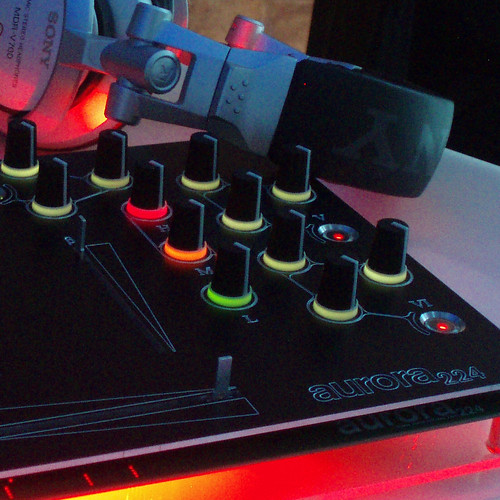
The open source DIY midi/DJ controlled called Aurora is now shipping in two assemble yourself kits. As I mentioned in our previous post this is an open source controlled that not only looks super functional, but looks good while doing it.
Kits come in two versions. The quick assemble kit that requires no soldering on your part runs for $340 US (Not bad IMO) and the complete soldering option runs $270.
Wow, it has been a few weeks since the last post hasn't it. Well hopefully I will get things kicked back into gear here with some new posts.
Everyone loves the Monome right? The 64x64 grid based wonder controller that can be used on everything from sequencing to drum triggers. Will it looks like there is a great DIY project out there to clone the Monome appropriately called the Arduinome. One of the prime advantages of this new DIY approach is that it is built upon the Arduino patch board, which allows the device to have an almost unlimited expandability approach. That is not to mention that it is dirt cheap as well.
Full details on the project can be found over at their WordPress blog: Bricktable
Do you have an old sampler that is beginning to collect a little dust because it doesn't have the sample memory that you need these days? Well for about $100 you can pick up the MCDisk-2 media card drive. It allows you to replace your old SCSI memory with Compact Flash cards to boost your memory up to 16GB. The unit comes as an external unit, but can be mounted inside many of the samplers listed.
Korg Triton Classic, Triton Studio, Triton LE, Triton Rack, Triton Pro
I personally love the concept, but I am curious as to how far your mileage will go. From my understanding many of these old hardware samplers have memory limitations built into their firmware.
You love Daft Punk's live shows, right? Who doesn't with their amazing visuals, giant pyramids and outstanding costumes. While it may cost you $65,000 to buy your own Daft Punk style helmet you can create your own EL suit for considerably less. Instructables.com has a great tutorial up for those DIY'ers who have the time and patience to build the suit. even better is the fact that this little DIY tutorial is lead by the very same person who created the original suits for Daft Punk. How about that?
Now here is an interesting concept that I thought we would have seen sooner. Take some standard off the shelf hardware, add some open source hardware, throw in a custom interface and you have yourself a great musical instrument at a fraction of the price of proprietary hardware. The Open Stomp is an open source stomp pedal that I presume basically takes software effects and puts them in a box. It uses the Coyote-1 sound effects processor and includes a Windows-based workbench for making sounds. No more details on the hardware specs, but it does have 1MB of storage (1MB? That is all?).
While it's a custom piece that's unavailable to the general public, the Kromatron (built by its namesake, top notch livepa performer and all-around cool cat Komega) is one of those one-off projects that deserves a bit of spotlight. While Komega's been working on it for some time now, the plans are now finalized and given a name. Komega's goal for the device is actually to enter it in a midi controller design challenge that features a brand new Tenori-On controller as its grand prize. From the Kromatron blog:
The Kromatron is a dynamic MIDI controller built specifically to interface with modern audio performance software such as Ableton Live. It has 4 knobs, 2 faders, a two-axis joystick, and 8 buttons. The device is 100% configurable and can change settings while the user is playing it. I call it a Meta-Instrument, because it holds 128 performance presets that can be activated by a simple MIDI patch change or program change signal.
Pretty close up photos, complete with explanations, are available at the blog. And as if Komega wasn't busy enough with that project, be sure to check out his other device, the Komegatone-- a modified PAIA Fatman synth transplanted into an old suitcase with a wicked custom face. What's next for Komega? We'll do our best to keep you posted.
I just had to post this one, being that U of I is my alma mater. So we have all seen Tesla Coil performances before. They are all the rage apparently. I don't think we have seen any quite as involved as this one however. So what we have here basically is a performance that occurred during the Engineering Open House that the University does every year to entice new slaves students to the engineering department. U of I for those not in the know has one of the country's primer engineering programs (I was in Poly Sci.....yes.....ahem). Anyways the department every year puts on these crazy demonstrations to wow students and parents on the campus and this year they did a Tesla Performance in a frightening cold 4 degree night. Check out the quote below for how they set it up. Click on the link above for the Quicktime video.
Mark Smart performs live in Urbana, Illinois on March 7, 2008. This outdoor concert was part of a student-run open house for the College of Engineering at the University of Illinois. Tesla coils were used to create musical pitches via a control system designed by university student Steve Ward. Two coils were used. The right coil is playing a pre-recorded Midi track, acting as the bass, and the left one is performed live as a lead sound via the Continuum fingerboard. The Midi track as well as additional audio backing tracks were played via Cubase running on a Open Labs Neko workstation. In spite of the frigid temperatures (4 degrees Farenheit, 26 mph winds), the concert was well attended and was voted the most popular event of the open house.
Way to go U of I. Did I also mention that the Haken Continuum is also one of my most desired pieices of musical equipment that I will never own? Yes.......Yes it is. Thank goodness this open house doesn't appear to have happened on the same day as "Unofficial St. Patties" day as it did a few years ago. Inside wink for any of you who were there back in 2004 or so.
Here is a video of a custom Lemur interface used to control Lucifer VST in Ableton Live. It is very cool. I didn't even know custom interfaces could be done with the Lemur. More of that stuff needs to start coming out, it really show the power of the Lemur platform.
Over at the LivePA.org boards user Vayperlok posted an interesting question regarding a keyboard and Ableton. Now I am sure all of us out there with laptops, especially those used for live usage are looking for the perfect midi controller. We have seen the popularity of Monome and others of its like, but Vayperlok brought up a really great idea. Could you use a POS keyboard instead of a QWERTY keyboard to achieve this goal?
Having an army of self programmable keys in front of you like that seems like it would be a fantastic solution for triggering loops and midi. Has anyone had any experience using a POS keyboard in Ableton or any other DAW? We would love to hear your opinion on the matter of how easy or difficult it is to not only program the keyboard but also setup the DAW software to accept an input keyboard for music notes.
Here is another great video sent in via reader Kevin that shows a trio of artists who are jamming away on two iPhones and a Nintendo DS. This is a great demonstration the power of some of these new devices and a great example of some of the amazing shareware that is also being developed outside the main software streams.
If you are looking for more great information on handheld of palm related music production tools, check out the excellent blog The Palm Sounds
Everyone loves lasers right? Sure you do. You are probably not really into harps however are you now. Now what if those harp strings were lasers? I would bet that you are a little more interested. In the video above we have a great laser harp constructed by Stephen Hobley.
Quote:
Stephen Hobley just perfected his laser harp. The audio is adjusted by breaking the beam between the source and mirror array above. No, you can't buy it, but we expect it to appear with a Ukrainian dressed in animal skins at Eurovision 2008.
The nice folks at Absurdity.Biz, who are responsible for the famous Bent Festivals, have been kind enough to host a video documentary on everyone's favourite glitchtastic pastime: circuit bending. From the tried and true Speak and Spells and SK-1s to more radical things like optical glitch synthesizers and art installations that gallery visitors can tweak themselves, everything about circuit bending seems to have been covered. The above video is the product of an ongoing documentary about circuit bending, other parts of which are sold on DVD at Bent festivals. It is truly worth watching even with the long running time. It is actually an entire DVD worth of film, so popcorn is recommended.
These are absolutely great. There are plenty of people out there who are DIY'ers for synths. Some may do something as simple as a PAIA kit, but others get as deep as doing it all yourself. ADACHI Tomomi, a composer and self-proclaimed DIY'er has these brilliant little DIY synths that he has made, using tupperware as the casing for the devices. Beautiful? No. Practical and Cheap? Yes!!!!
ADACHI's self-made instruments are consists of simple electronic circuit, almost case built in tupperware. They never can make precise pitch, but have good sound and noise, easy to operate and carry and worked by battery. Of course the funny and pretty looks are important aspects. In this page, you can see the images from them (more sound files come soon...)
The latest, tiniest invention to hit the synth scene comes from fledgeling one-man synth company Chimera Synthesis, and features an analog VCO, LFO, ADSR envelope, VCA, VCF, ring mod and noise generator, all in a case the size of a cd! Packed into that space are also sixteen dedicated knobs, a headphone jack, and a space for two nine-vold batteries; alternatively, it can be run from a third-party +/-8 to 12 volt source. The website is under consruction and somewhat short on details as of the time of writing, but it does say that the Bc16 can be used with a MIDI/CV converter or hooked up to other Bc16s. Future updates there will (hopefully) give us sound demos of some kind.
I am a composer and producer of electronic music, as well as an independent blogger/podcaster on music production.
You can find my music at dynamicinterplay.com.
In addition to composing I also run a podcast called The Electronic Musician, which covers various topics on composing electronic music.
I am also a moderator at serious-sounds.net, a production community for artists.
Looking to become a writer for the LivePA Blog? Got a question about LivePA, or are you just looking to get your music or livesets heard on the site? Then send us an