Showing posts with label midi. Show all posts

Wednesday, December 31, 2008

Elysium Generative Midi Sequencer by LucidMac Software

0 comments


Elysium by LucidMac Software

There are not many of us out there who are still looking for strictly a midi generator out of our music software, but there are some in the sea still. If you are looking for something a little bit more interesting from your midi sequencer then you may want to consider Elysium by LucidMac Software. Elysium is a generative midi sequencer that utilizes a unique honey comb type grid to build upon its sequences. It is strictly midi, but the creator states that you can render all the sequences out to another workstation such as Ableton Live or elsewhere.

Quote:

"Elysium is generative which relates to the way the music is created by building up a “system” composed of layers, cells, tokens, and playheads that combined, when “played”, to produce a sequence of notes."


It is available as a free download, but is Mac OS X 10.5+ only. Give it a download and let us know what you think.

via Orju.net

Thursday, April 10, 2008

The Past Gets Futuristic Again: Atari STeem and Dr.T's KCS

1 comments

The Past Gets Futuristic Again: Atari STeem and Dr.T's KCS
Photobucket
Here we explore the nebulous place where the cutting edge meets low-tech minimalism.

In 1987, the Atari 1040 hit the market, sporting an 8mhz processor and a then unheard-of 4 megabytes of RAM. Its integrated MIDI ports made it a contender against the other popular music computer of the time, the Commodore 64, and the operating system (called TOS, which stands for... The Operating System) was so microscopically small that it fit onto a single chip, making a hard drive optional. Much of the MIDI software written for this no-frills skeleton of a system followed suit, offering stark, eye-gouging interfaces that were packed with cryptic but highly efficient functions often hidden in plain sight. Of these, C-Lab's Notator software reigned supreme, offering an amazing array of MIDI editing the likes of which I have never seen anywhere else.

My 1040ste unit has seen some hard times over the years of daily use. I've repaired it many times, gone through two monitors, and given it more than its fair share of pounding and overheating. Thankfully, the engineers at Atari were bright enough to encase most of the unit's internal components under removable metal shells. Nothing lasts forever, though, and each passing day of suspiciously flawless performance makes me wonder: how long will this machine last? It's nearly as old as I am, and replacement parts are hard to come by. If WHEN it bites the dust, the heart of my studio will be ripped out. So, I went searching for a modern solution.

Of the of Atari emulators I tested on my laptop (an HP Pavillion) the best was Atari STeem. Not only does it faithfully emulate any of the 1040 series, the software can also run much, much faster than the hardware unit, allowing virtual overclocking and RAM expansion up to an otherwise impossible 14mb. Unfortunately, the program also brings some stability issues to the table that were never present in the hardware unit, but with modest performance settings this are easily managed. Unfortunately, C-Lab Notator cannot run under STeem, because nobody has managed to emulate Notator's hardware lock. Consensus among Atari MIDI buffs says that it could theoretically be done, but it would technically be illegal, and also heinously difficult. As I am no Atari guru, I went in search of another solution to my MIDI needs.

The answer came in the form of Dr. Emile Tobenfeld's KCS Omega II software, a visionary MIDI editing suite completely unlike any other I have ever seen. The last official release was in 1993, but the software is easily had online at Tim's Atari Midi World. It is, as the documentation states a combination of several midi programs that work together under a multitasking environment called the Multi Program Environment, or MPE. Packed inside are programs like the Programmable Variation Generator, the TIGER graphical editor, a MIDI automation mixer, song mode, and a score editor. Each of these is complex and can be used as a program of its own, or in concert with the other programs. The main attraction for me is the Keyboard Controlled Sequencer for which the program is named. It runs in two modes, Open mode and Track mode. In Track mode, the program offers 48 MIDI tracks controlled with tape-style transport controls and a host of editing functions. Open mode allows the user to independently loop and playback 128 separate sequences via keyboard-mapped MIDI phrases, for a kind of live, hands-on approach to MIDI composition one might not expect from such an old program. That's right, it's an Atari sequencer that can be used live, quite possibly to great effect. Both modes offer extremely in-depth programming and a few unexpected functions.

Even better, STeem's MIDI faculties handled information to and from my MOTU Fastlane USB/MIDI box without any latency issues. In fact, setting up MIDI under STeem was far easier than under Reason, Cubase, Adobe Audition or any of the other modern software I use. The clock is solid and the stability is absolutely amazing, especially considering that Windows Vista can't get that kind of stability out of any other program. The KCS software's learning curve is somewhat steep, and could potentially throw off the modern user who has been spoiled by dumbed-down functionality and slick graphical interfaces. It is greatly worth learning, however, because the depth of MIDI programming capability offered by KCS is astounding.

Saturday, January 26, 2008

Dust off your NES

0 comments


The current wave of 8-bit mania continues with this little find, the Midines from Wayfar. This retrofitted game cartridge turns any original Nintendo into a midi-capable tone generator by giving the user access to the console's onboard sound chip as well as a fully programmable midi connection via the midi cable mounted at the back of the cartridge. As the website states: Midines provides full access to the 2x Pulse, Tri, Noise and DMC (sample) channels. Including access to sweep, duty, volume and length sound registers. The sound routine is not dependent on the vertical screen refresh rate (vblank) allowing high speed MIDI CC modulation of all parameters. That pretty much sums it up in technical terms. Also included on the cartridge's ROM is a library of 256 all-star drum machine samples and other chiptune essentials, featuring the famous 707/808/909 series, the amen breakbeat, and others.

Each cartridge is made by hand, and reviews found around the web say this has a tendency to result in long wait times. Nevertheless, the unit can be had for $89 American plus $10 for shipping, a bargain considering what it is. Be sure to check the homepage's audio demos as well. Not recommended for midi n00bz, as an in-depth working knowledge of midi and a good sequencing platform are essential in order to program this unit effectively.

Saturday, March 10, 2007

Synthesizer Patch Database: Synthbase.net

0 comments

.:Synthbase.net:.

Looking for some new patches to load into your favorite hardware or software synthesizer? Well Synthbase.net might just have you covered. Synthbase is a site dedicated to collecting patch banks for different types of synthesizers. While you are at it be sure to share your custom made patches as well for others to download and use.

The site predominately has what appears to be hardware synths, but there is a healthy collection of software synth patches in the mix as well.

Tuesday, March 06, 2007

The MusicPole Midi Controller

0 comments


.:MusicPole.com:.

Here is another one of those crazy midi control devices. The MusicPole, which has midi triggers arranged around a cylinder. What is interesting with this is that you don't tap the triggers, but instead glide your finger across them. You can purchase a MusicPole for $395.

The MUSICPOLE MIDI Controller is a brand new musical instrument.

You don't strike the keys of the MUSICPOLE like you would a piano, you stroke the keys like a slide guitar player. By sliding your thumb you can create all the different scales.

The 12 musical keys are labelled around the top of the MUSICPOLE. The MUSICPOLE's key's are arranged symmetrically, like the circle of fifths. The MUSICPOLE is a 3 octave keyboard. The keys have the same black and white scheme as piano. All keys are labeled with their proper note names.

The MUSICPOLE's keys are triggered by special "thumbletz" you wear on your thumbs (thumbletz are made out of conductive fabric. They slide like silk over the keys of the MUSICPOLE).

Sunday, February 11, 2007

Audio Cubes: Experimental Control Device

2 comments


.:Percussa Audio Cubes:.

I have been hearing about these little Audio Cubes from people who have been at NAMM. Apparently these little cubes are some experimental control interface that can manipulate music based on how you position and move the cubes. Compared to to some of the other academic experimental interfaces around, the Audio Cubes are actually being developed for commercial use, and the website even has some videos of it doing some practical control of an Elektron Machinedrum and Ableton Live.

AudioCubes is a tangible interface for sound design and exploration, under development at PERCUSSA. The interface consists of an arbitrary number of plastic cubes. Each of the cubes is capable of sound processing.

The cubes can be connected to a computer and can be programmed to process sound signals. By positioning and moving the cubes relative to each other, sound processing can be changed and a variety of sounds can be quickly designed and explored.

Sneak-Thief: Building a DIY Hardware Sequencer

0 comments


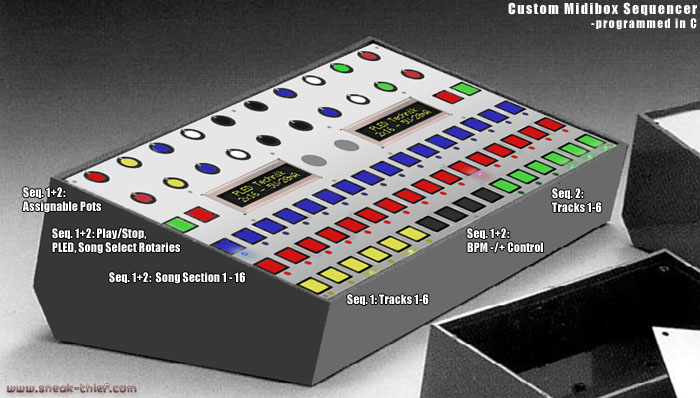
LivePA artist Sneak-Thief is quite the custom DIY hardware guru. He has built several custom machines including an ASM-2 modular synth and a Nord Micro Modular inside a Yamaha RS7000.

Well this time he is out to build a custom hardware midi sequencer based off of the Midibox specifications, but using a custom OS which will allow up to 256 measure patterns. Sneak plans to put up a building journal so I will post information to that when it is avaliable. Below is the info.


Basically, I need something lighter to replace my ageing RM1x. To recap, I currently use the RM1x to sequence Kontakt 2 which is loaded with 6gb of my home-made loops and samples. The pots control various effects and scripts in Kontakt.
I'm in the process of developing a very simple pattern sequencer that supports up to 256-measure long tracks. I'm going to use the Midibox as my platform and write everything in C (no I can't use the Midibox Sequencer because it's much easier to start from scratch)

Here are the specifications:
1. 2 independent sequencers, one of which can be slaved to the other.
2. Each sequencer will be able to load one "song" at a time. A song is chosen by the push-button rotary encoder.
3. 16 sections per song
4. 6 tracks per section that can be muted or unmuted with the track-mute buttons (more than 6 tracks could be implemented, but that's all I need)
5. 256 measures per track - this is where this really differs from the Midibox Seq
4. Components

Midibox modules:
2x Cores
2x AIN
2x DIN
2x DOUT

The total cost is roughly 180 euro (~$235 US). You can save 20 euro by getting LCD's instead of PLED's - but PLED's look so fucking nice. I've already ordered everything and the hardware should be finished next month. Then comes the hard part I'll be posting build pics next month.

cheers,
michel

Friday, January 26, 2007

Luciana Haill: Litterally Producing Music With Her Mind.

1 comments


.:Luciana Haill Information:.

Ok, talk about doing it live. Luciana Haill (awesome name btw) is making music with her brainwaves, by hooking up an electroencephalogram (EEG machine) wired with bluetooth that then runs to her computer. The data sent via bluetooth then triggers samples to form a song. She is taking her great idea on the road with thirty other artists in the .:Future of Sound Tour:. allowing audience members to wear the headset and participate in the music.

.:Video/Audio Examples:.

quote via Wired.com

The brain operates in the same units sound waves are measured in -- hertz," said Haill. "You're getting raw data from the prefrontal cortex but feeding it through software -- a little bit from the left hemisphere and a little bit from the right...I want to create something that we can all listen to even if we don't quite understand it... I want people to understand that brain waves are changing. It's not something you could have as a ringtone, but you could trigger a film clip, for example, when your mind is slipping into that twilight."

Haill has been using her brain-scanning hardware for the last 14 years to play MIDI with her mind, but says it is the inter-application events protocol in Apple's OS X operating system that allows her to trigger different GarageBand samples and other devices for each type of neuro activity and for each side of the cortex.