Showing posts with label circuit bending. Show all posts

Monday, November 16, 2009

Ableton Live Controlled with Xbox 360 Controller

2 comments

We have seen our fair share of Wii controllers, taking on software for live performance. I have not however, seen something directly controlling Ableton nor have I previously seen an Xbox 360 controller doing it. The video is a little grainy, but is a nice demonstration.  Unfortunately, I don’t see any  explanation of how it is actually done.

via MatrixSynth

Friday, November 13, 2009

Arduino Didgeridoo

1 comments

Not really a LivePA video, but this is a fantastic video of a didgeridoo modified with an arduino chipset. Incredible how cool drone sounds can be. 

Thursday, July 10, 2008

Aurora: Open Source/DIY Midi Controller

2 comments


aurora Open Source DJ Mixer\MIDI Hardware w/ Ableton Live from mcubed on Vimeo

AuroraMixer.com

Now here is something that is hot. The Auroroa Mixer is an open source build it yourself DJ mixer/midi controller that is absolutely beautiful. The device is developed by three individuals who each had a hand in designing the firmware, design and electronics.

Quote:

Aurora is a usb powered multichannel mixer in a typical dj form factor. the device features two linear channel faders, a single a/b crossfader and eight backlit buttons. twenty four backlit knobs allow you to control effects. aurora, unlike most midi controllers, enhances performances with controllable ambient lighting. aurora easily integrates with your favorite midi compatible software.

I hope all of your Ableton live guys out there are getting ready for this thing because it could really change everything we are doing for control surfaces. It has the M-audio design flair and I would not be surprised if we see a manufacturer pick this thing up. I also can't wait until the DIY'ers get a hold of this and start making hacks and all sorts of tweaks. I am looking for the full 64 knob version coming soon.

via Gizmodo.com

Sunday, March 09, 2008

Circuit Bent Tr-505

0 comments


The Roland Tr-505 was the trailer trash cousin of the famed Tr-x0x line. Unlike the other Tr models, the 505 was built for budget musicians. Even the individual outs were missing, and one could not edit the samples. The memory held a paltry 48 patterns and six songs. It did, however, get a decently useful midi implementation and some tiny attractive drum pads. For those reasons, it is a machine ripe for circuit bending. The above video shows just what happens when you start wrenching the guts of this easily had and otherwise forgettable little box.

Saturday, October 20, 2007

Last MIT Flea Market of 2007 Tomorrow!!!!!!

0 comments

.:Last MIT Flea Market of 2007 Tomorrow!!!!!!:.

For those of you circuit bending maniacs out there, tomorrow is your last chance to hit up the MIT Flea market for 2007 for your last bit of wires, transistors and all the other good stuff.

For more complete information on the MIT flea market, be sure to hit up my previous post on it .:here:.

Wednesday, September 19, 2007

MysteryCircuits.com - DIY Circuit Bent Projects

0 comments


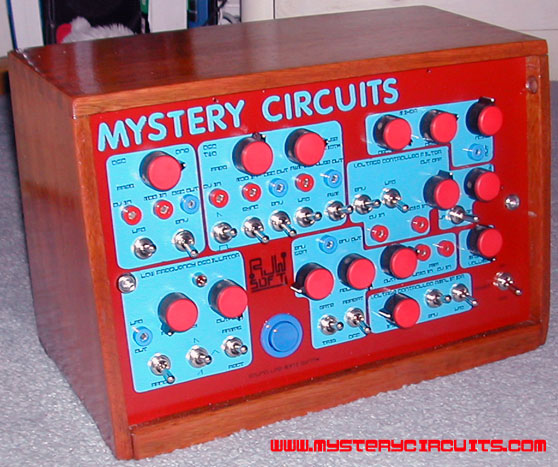
.:MysteryCircuits.com:.

Looking for some interesting circuit bending projects? Well the projects of Mike Walters span the entire gamut of circuit bending from bent toys to bent synthesizers. Click on over to find out information on each of the projects that he has completed.

Sunday, June 17, 2007

MIT Electronics Flea Market!!! Today June 17th and Every 3rd Sunday!!!

0 comments


.:Flea Market Flyer (.PDF):.

Short notice on this one. Super short, but I just learned that MIT is having an electronics flea market for all of your circuit benders, radio junkies and the like. If you are in the area, head on over today and get a good deal on a 1,000 pack of resistors or a circuit bent Furby.

If you happen to miss today's market, fear not. This is going to be a monthly event from now until October, occurring on the third Sunday of every month.

Quote:

The MIT Radio Society, in conjunction with the MIT UHF Repeater Association, the MIT Electronics Research Society, and the Harvard Wireless Club, sponsors a Swapfest on the third Sunday of each month, April through October. This is a place to buy, sell, and swap amateur radio, electronic, and computer equipment. Hams and non-hams alike are welcome.


via EM411.com

Saturday, June 09, 2007

Create Digital Music - Monomes Aplenty: New Models Coming, and Enough Buttons for All

0 comments


.:Create Digital Music - Monomes Aplenty: New Models Coming, and Enough Buttons for All:.

Damn Createdigitalmusic and their insider connections and access to professionals. Looks like the indie popular control surface Monome is rolling out some new options with loads more buttons.

The new models will be in 8x8, 8x16, and 16x16. For full info on kits, building, and all that other jazz, head on over to .:Monome.org:.

Saturday, May 12, 2007

Getting Started with DIY Synthesis

2 comments

.:Getting Started with DIY Synthesis:.

A new forum has opened up over at the LivePA.org Board that is going to cover topics related to DIY and self built gear. To kick things off selfdestroyer has posted a nice thread that outlines a bunch of great resources to get started with DIY. Topics range from where to find your first parts, to how to learn how to solder. For anyone looking to getting involved in some DIY or circuit-bending, this is a great first step to find out what is out there.

Sunday, April 29, 2007

Photos from the 2007 Bent Festival

0 comments


Make magazine has pictures as well as some information and links about this past weekend's Bent Festival in New York.

The Bent Festival is a festival held in New York, Los Angeles, and Minneanapolis. Each year circuit benders from across the country are invited to conduct workshops on circuitbending and also setup performances for musicians using circuit bent gear.

For more information, and details about the next Bent Festival head on over to .:bentfestival.org:.

Saturday, March 31, 2007

Sneakthief's Custom Built Midi Sequencer

2 comments


.:DIY MIDI Sequencer:.

Livepa.org member Sneakthief has been building himself a custom midi sequencer for use at his live shows. The basic build design is taken from the Ucapps.de site, but he has designed custom code for the sequencer. You may be thinking that the sequencer's design is a little unorthodox, but he has designed it not to write his music out on, but rather just perform it. Sneakthief states that all of the composition will actually be done on other modules and he will then load all of the midi sequences on to the box for performance. He has some great ideas in here that I am surprised no other sequencers have used these, such as two independent yet syncable sequencers. They can work together, yet if one goes down the show is not over!!!

The complete build discussion, as well as tons of pictures can be found at the link above.

Quote's from Sneakthief on the idea:

I'm in the process of developing a very simple pattern sequencer that supports up to 256-measure long tracks. I'm going to use the Midibox as my platform and write everything in C (no I can't use the Midibox Sequencer because it's much easier to start from scratch).......I'm not going to write music with this - at the moment it's strictly for live performance so I'll be loading sequences from my other boxes...... As time goes by, I'll be able to program new features.......what's nice about the dual lcd's is that they're 2 totally independant hardware sequencers that can either run separately or in sync. more importantly, if one ever dies (highly unlikely), i won't be screwed over!


Specs:
Here are the specifications:
1. 2 independent sequencers, one of which can be slaved to the other.
2. Each sequencer will be able to load one "song" at a time. A song is chosen by the push-button rotary encoder.
3. 16 sections per song
4. 6 tracks per section that can be muted or unmuted with the track-mute buttons (more than 6 tracks could be implemented, but that's all I need)
5. 256 measures per track - this is where this really differs from the Midibox Seq
4. Components

Midibox modules:
2x Cores
2x AIN
2x DIN
2x DOUT

Thursday, March 29, 2007

Sound Comparison of Gameboys, for Chiptune Artists

0 comments


.:Gameboy Sound Comparison:.

Musican Herbert Weixelbaum has setup a very nice sound comparison of all of the gameboys to analyze their sound for chiptune music production. The result is a very nice side by side comparison that points out the differences in sound as well as visuals of the waveforms that each gameboy produces.

The gameboy is becoming quite popular as a live performance tool as of late with tool such as Nanoloop and LSDJ.

via Joystiq.com

Monday, February 19, 2007

Garages, Radios and The Altair 8800: How hackers invented music for personal microcomputers

0 comments


+ + Listen. + +

Personal microcomputers had a rocky start. Before the golden era of user dominated personal computing, personal computers made wonderful bookends, and that was about it. Back in the year 1975, the shag haired, pocket-protector wearing hackers of Silicon Valley's Homebrew Computing Club found their exuberance for their new technology only slightly dampened by this fact; being technology fetishists back before having a fetish was cool, the potential held by home computers far outweighed their initial apparent uselessness. Take, for instance, the Altair 8800. It was the first personal microcomputer to hit mass production. It could be bought fully assembled, or for cheaper in a kit. It was, as these pictures show, basically just an lame little box with lights and switches, and that was it. No keyboard, no monitor, no mouse. No hard drive. Minesweeper and solitaire were not included with the OS, as there was no OS. While capable of running programs and carrying out complex mathematical calculations, it had one stunning basic problem: a total lack of input and output devices.

One night, as Homebrew Computing Club member and HAM radio enthusiast Steve Dompier hit the 'run' switch on the front of his Altair, something unexpected happened; his nearby shortwave radio gear emitted a sudden blast of irritating atonal garbage. Investigating the problem with the aid of a guitar, he tracked and mapped one note ( f-sharp) to a specific section of the Altair's memory; after that, he began to logically map out the rest of the tones on the harmonic scale to their respective memory locations in the Altair's RAM. It is worth noting that this was simultaneously the birth of music for the personal computer, the first documented successful program for a personal microcomputer, and the discovery of the first I/O device for the personal computer, all at the same time. After eight hours, Dompier had mapped the scale, created the very first note sequencer, and had begun programming in the first piece of sheet music he could find: 'Fool In The Hill' by The Beatles (linked above).

When he debuted this at the next meeting of the Homebrew club, it left the crowd absolutely speechless. Up until that point, not even the most dedicated home computing enthusiast had seen one of their coveted boxes do something, much less do anything so cool as playing music. It had been done before, but only massive machines that lived deep inside of laboratories. When the screeching, buzzing rendition of McCartney and Lennon's hit song finished crackling its way through the speaker on a small portable radio, absolute silence reigned. And then, the music unexpectedly began again, this time playing another composition-- a song called Daisy.

Daisy is a short composition by a man named Max Mathews, and we all owe him a lot. During his time as a researcher at Bell Laboratories, he invented sound synthesis, and in 1957 programmed an IBM 704, a computer that required an entire room of its own, to play his seventeen second composition. Oddly enough, it is this very song which HAL plays as he is dismantled at the end of 2001: A Space Oddyssey.

It's strange to look at a product like Ableton Live, Protools or Final Scratch with the Altair in mind. While the fusion of music and computing technology was a logical eventuality, it's still a shocking thing to behold such humble roots. Not only that, knowing stuff like this impresses punters, believe me. More about the Altair can be found at Digibarn.com, source of the sound file above. Special thanks to Bruce at Digibarn for his assistance in putting this article together.

Monday, January 22, 2007

MAKE: Blog: Video Podcast Introduction to Circuit Bending

0 comments


.:Make Circuit Bending:.

This week's Make Video Podcast has a fantastic introduction and how to into circuit bending. In this episode they bend the classic Speak N' Spell, and a few other toys. If you subscribe to the podcast there is also a PDF avaliable with high resolution photos and instructions on what they did.

You guys know how much I have blogged about Make Magazine on this post over the past couple of months. As a little form of advertising for them I highly reccomend to any of you out there. If you subscribe to one video podcast in your life, check this one out. Also try giving the magazine a try at your local shop. It is a little expensive, but it really is great to support something like this.